
















ADVENDURE is the leading web portal in Greece about Mountain Running, Adventure, Endurance and other Mountain Sports
info@advendure.com



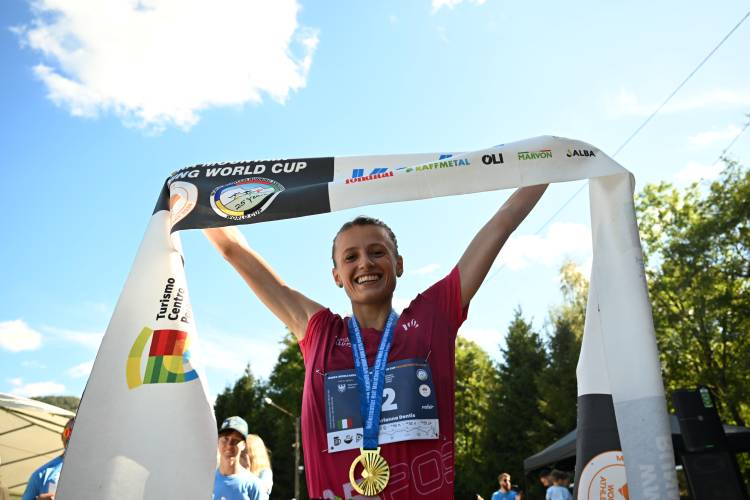 Arianna Dentis wins Rollercoaster 21 at Maraton-Trzech-Jezior 2026 Maraton-Trzech-Jezior by Jan Nyka.
Two commanding performances bring Arianna Dentis (ITA) and Martin Nilsson (SWE) their long-awaited first victories in the WMRA Mountain Running World Cup.
Arianna Dentis (ITA) and Martin Nilsson (SWE) claimed their first WMRA Mountain Running World Cup victories of their careers at Rollercoaster 21, closing the Long Distance season with two decisive performances in the Beskid Mały mountains.

Arianna Dentis (ITA) had waited a long time for this moment. After months of racing across the World Cup circuit, the dedication and persistence behind her season finally carried her to the top step of the podium. She controlled the women’s race from its opening stages and crossed the line in 1:55:03, almost four minutes ahead of Maya Rayle (USA).
Martin Nilsson (SWE) produced an equally authoritative performance in the men’s race. After remaining close to the early pace, he moved clear over the second half of the course and won in 1:38:50, more than three minutes ahead of Finlay Grant (GBR).
The victories also moved both winners up one position in the overall World Cup standings. Arianna Dentis (ITA) climbs to sixth and Martin Nilsson (SWE) moves from ninth to sixth, giving each athlete further momentum before the final World Cup weekend in Canada.
DENTIS TURNS DEDICATION INTO VICTORY
Arianna Dentis (ITA) established control early. At the 7km checkpoint, she already held a lead of more than one minute and 40 seconds over Maya Rayle (USA). From there, Dentis continued to extend her advantage across the repeated climbs and technical descents of Rollercoaster 21.
By the finish in Porąbka, the margin had grown to 3:48.
The victory rewarded a season in which Arianna Dentis (ITA) had already competed at the Broken Arrow Ascent and Broken Arrow Skyrace, Grossglockner Mountain Run, both races at Vauban Mountain Trail, Vertical Nasego and Trofeo Nasego. Poland was her eighth World Cup start of the year and the race in which all that work finally produced her first victory.
For Arianna Dentis (ITA), the finish in Porąbka marked the end of a long wait. Her commitment across several countries, categories and different types of mountain terrain was rewarded with a performance in which she took responsibility for the race from the beginning and never allowed her lead to come under threat.
Maya Rayle (USA) completed an impressive World Cup debut with second place in 1:58:52. Céline Aebi (SUI) secured the final podium position in 2:02:04 surprising even herself with her strong performance.
Eden O’Dea (GBR) finished fourth, closely followed by Natalie Beadle (GBR) in fifth. Rena Schwartz (USA) placed sixth, ahead of Selina Burch (SUI) and Sara Willhoit (GBR).
There was also a home top-10 finish for Izabela Wysluch (POL), who crossed the line ninth. Alicia Shay-Vargo (USA) completed the first 10.

MARTIN NILSSON TAKES CONTROL ON THE ROAD TO PORĄBKA
The men’s race developed differently, but the final margin was just as convincing.
Maciej Lachowski (POL) was the quickest runner at the 7km checkpoint, passing through in 31:21. Martin Nilsson (SWE) was only 12.3 seconds behind, well positioned before the course entered its later sequence of climbs and descents.
From there, Nilsson took control. His strength across the full course allowed him to move clear of the leading group and build a winning margin of 3:07 by the finish.
After several strong World Cup performances during the season, including eighth place at Trofeo Nasego, Martin Nilsson (SWE) converted his consistency into his first World Cup victory.

Martin Nilsson at Rollercoaster 21 at Maraton-Trzech-Jezior 2026 - copyright WMRA • Marco Gulberti
The closest racing came behind him.
Finlay Grant (GBR) made significant progress during the second half of the course. Sixth at the 7km checkpoint, his strength and confidence on the descents carried him through the field and into second place. He finished in 1:41:58.
Paul Knight (USA) remained close throughout and crossed the line just 5 seconds behind Finlay Grant (GBR), taking third in 1:42:02. Paul Knight (USA) brought 28-minute 10,000m credentials to Poland and demonstrated that speed on the track could be transferred to a demanding mountain course of steep climbs and technical descents.
Luca Merli (ITA) finished fourth, ahead of Pavol Orolin (SVK). Maciej Lachowski (POL), who had led at the checkpoint, was the first Polish runner home in sixth.
Oscar Subuh-Symons (GBR) placed seventh, followed by Casey Campbell (USA). Andrew Douglas (GBR) and Karol Matyssek (POL) completed the men’s top 10.

INTERNATIONAL QUALITY STRENGTHENS THE FIELD
The United States team brought real quality to the Long Distance final, but the strength of the field extended well beyond one nation, with six nationalities represented in the men’s top 10 and five in the women’s.
Maya Rayle (USA) finished second and Paul Knight (USA) secured third, while Rena Schwartz (USA), Alicia Shay-Vargo (USA) and Casey Campbell (USA) also placed inside the top 10.
POLISH MEADOWS AND UNFORGIVING CLIMBS
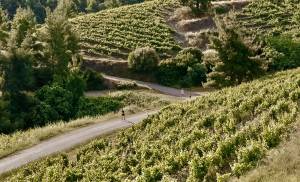
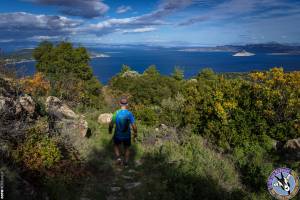
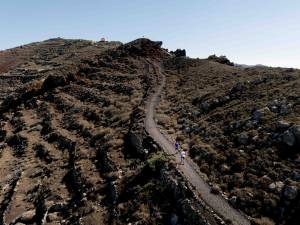
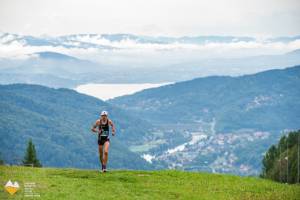
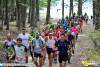
Beautiful weather opened up views across the meadows, forests and lakes of the Beskid Mały. The landscape reflected the character of Poland’s middle mountains: welcoming and open in places, but crossed by gradients and technical trails that gave the race a much harder edge.
Rollercoaster 21 covered 21.6km with 1,511m of ascent. From the start in Międzybrodzie Bialskie, the runners climbed more than 500m during the opening three kilometres towards Czupel.
A long and technically demanding descent then carried the race towards Czernichów. After crossing the Soła River, the course began climbing again, eventually reaching one of its defining sections on the way towards Mount Żar.

Maya Rayle (Team USA) at Rollercoaster 21 at Maraton-Trzech-Jezior 2026 - Photo copyright: WMRA • Marco Gulberti
The constant changes of gradient made it difficult for the athletes to establish a steady rhythm. Strong climbing alone was not enough. The runners also needed the confidence to descend quickly, the control to move efficiently across the technical sections and enough strength for the final approach to Porąbka.
The Three Lakes Marathon festival provided a distinctly Polish setting for the World Cup. Open meadows, wooded slopes, steep trails and views across the lakes placed the international field within a landscape closely connected to the area’s outdoor culture.
THE LONG DISTANCE SEASON ENDS AS THE WORLD CUP LOOKS TOWARDS CANADA
Rollercoaster 21 was the 14th race of the World Cup season, which has already visited Portugal, China, Spain, the United States, Austria, France, Switzerland and Italy.
It was also the fifth and final Long Distance race of the year, following Transvulcania Half Marathon, Broken Arrow Skyrace, Sierre-Zinal and Trofeo Nasego.
The overall World Cup now moves to Défi des Couleurs in Canada on 10–11 October. The Uphill final will take place on Saturday, followed by the Up & Down final on Sunday.
Arianna Dentis (ITA) and Martin Nilsson (SWE) will arrive in Canada higher in the overall standings. More significantly, they will arrive as World Cup winners for the first time.
IN MOUNTAIN RUNNING WE TRUST.
About the WMRA:
Formed in 1984, the World Mountain Running Association is the global governing body for mountain running and has the goal of promoting mountain running for all ages and abilities.
As well as the World Cup, the WMRA organizes Masters, U18 and area championships and in partnership with the World Athletics, ITRA and IAU to deliver the World Mountain and Trail Running Championships, with the last event held in CanfrancPirineos Spain in 2025. The WMRA also maintains the Mountain Running World Ranking, a system of points allocated to athletes based on the results in designated races.





ADVENDURE is the leading web portal in Greece about Mountain Running, Adventure, Endurance and other Mountain Sports
info@advendure.com